Decompression belt vs inversion table: what each does and what the evidence says
Last updated 2026-11-07 · Written by Inversion Guide editorial team
Disclosure: if you buy through our links, we may earn a commission at no extra cost to you. As an Amazon Associate I earn from qualifying purchases.
For information only. This page is general product information, not medical advice. Talk to your doctor or physiotherapist before using an inversion table.
Inversion tables are not for everyone. Read who should not use one first.
We research; we have not tested a belt or a table. Evidence statements come from the pages in our sources, last checked 30 October 2026. We show no prices, because they change often.
Decompression belt vs inversion table: the basics
| Decompression belt | Inversion table | |
|---|---|---|
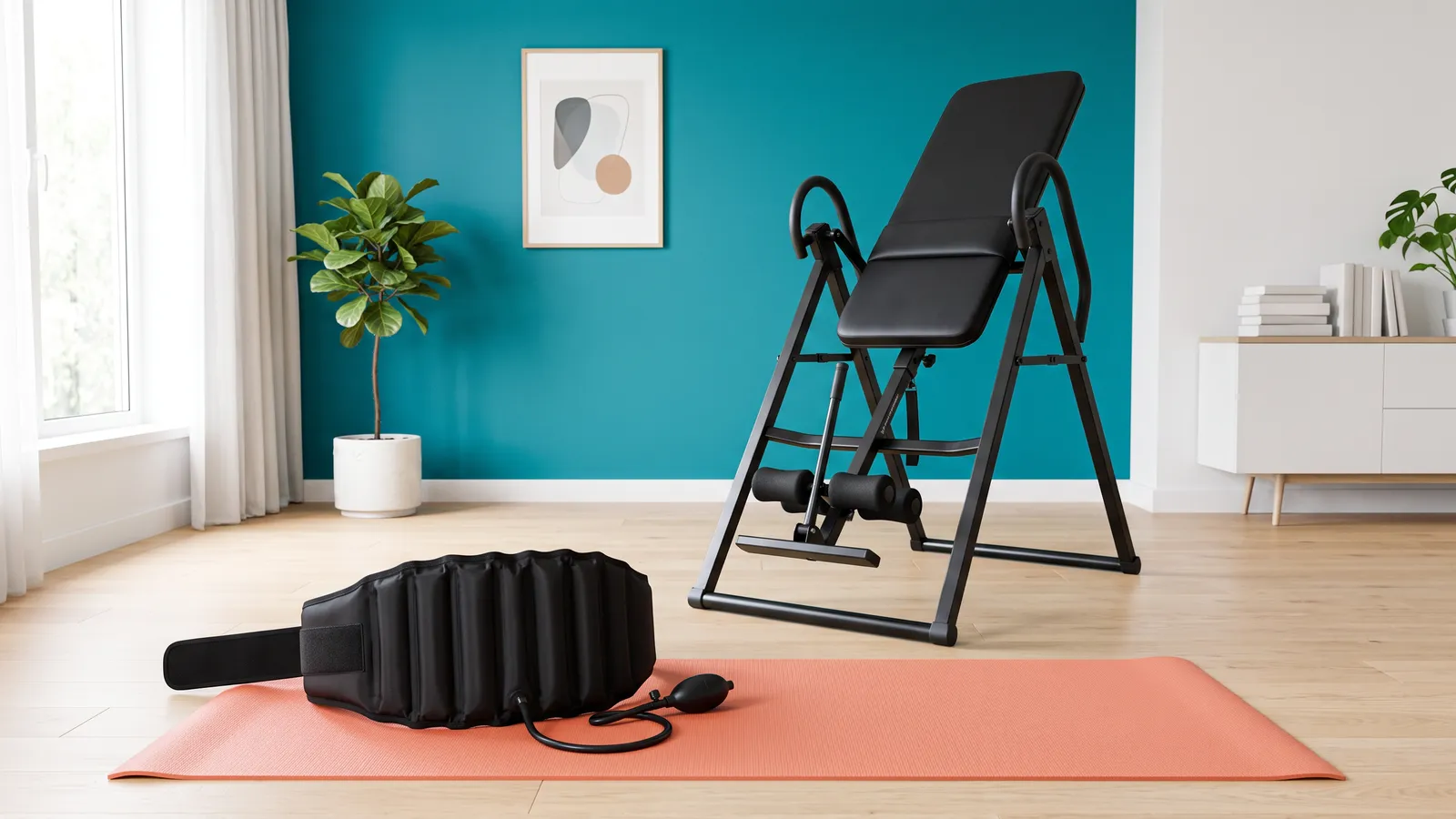
| What it is | A lumbar support worn around the waist. Some inflate with a hand pump. | A frame you strap onto at the ankles and tilt back, from a slight angle to fully inverted |
| What sellers say it does | Creates "air traction" or space between the vertebrae | Uses body weight and gravity to stretch the spine |
| Where you use it | Standing, sitting or walking, as you choose | Lying on a table, ankles locked, tilted back |
| Body position | Upright | Head down or tilted |
| Typical safety questions | Fit, skin comfort, relying on a brace | Blood pressure, eyes, heart, ankles, getting off the table |
| Independent evidence | No trial of inflatable decompression belts found; evidence on lumbar supports in general is very low quality | Cleveland Clinic says inversion is a form of traction; trials are small |
The seller descriptions come from product marketing pages, not from independent studies. Treat them as claims.
What the evidence says
Lumbar supports. A Cochrane review reported on 2 September 2026 found very low-quality evidence on lumbar supports for chronic low back pain, so no strong recommendation can be made for or against them. Across most comparisons they showed little to no benefit or very uncertain effects. The one possible exception was a small short-term reduction in pain when a support was added to pain medicine. That review is about lumbar supports in general, not inflatable decompression belts.
Traction. Cochrane's review of traction for low back pain found low- to moderate-quality evidence that traction may make little or no difference to pain, function, overall improvement or return to work for mixed groups. For chronic low back pain without sciatica, it found moderate-quality evidence that traction probably makes little or no difference in pain compared with sham treatment. NICE guideline NG59 advises against offering traction for low back pain with or without sciatica. Our inversion table vs traction page goes through that.
Inversion tables. Cleveland Clinic describes inversion as a form of spinal traction and covers the limited evidence and the risks. The same cautions apply: small studies, not strong proof.
So the honest answer is that neither is proven. A belt is lower risk, because you stay upright. That is not the same as being effective.
Who might lean towards a belt
- You cannot or should not invert, for example because of blood pressure, eye conditions or a heart condition (check the safety list).
- You want something portable that you can wear upright.
- You are fine treating it as a comfort aid, not a treatment.
Things to keep in mind: a belt is a support, and Cochrane found little to no benefit across most comparisons. If one makes you rely on it, or your pain is getting worse, see a doctor.
Who might lean towards a table
- You have already been told by a doctor that inversion is fine for you.
- You want to set your own angle and start low. Teeter and Innova both advise new users to begin with a small angle and short sessions. See what angle to invert at.
- You have room to set up and store it. Our space guide covers footprint.
Think about the cost of being wrong. A table takes more money, more space and more care to use safely, and not everyone should invert. If you are unsure, talk to a doctor or physical therapist before buying either.
Alternatives that cost nothing
If your goal is a gentle stretch, our guides on a dead hang and a back stretcher cover other low-tech options. These are not tested by us and carry their own limits.
If you still want a belt
We have not verified any decompression belt, so we do not recommend a model. If you shop for one, look for:
- Clear sizing against your waist or hip measurement, since an ill-fitting belt rides up or digs in.
- Honest claims: be wary of promises to "cure" or "reverse" a condition. None of the independent sources we read support that.
- A return policy, in case it does not fit or irritates your skin.
Search decompression belts on Amazon
Prices change often. Check the current price on Amazon.
Our best inversion tables page covers the tables we have verified, if you decide to go that way.
Common questions
Is a decompression belt better than an inversion table?
Neither has strong evidence. They are different tools. A belt keeps you upright and has fewer inversion-specific risks, while a table gives you a stronger stretch. Cochrane found little or no benefit from traction and very low-quality evidence for lumbar supports.
Does a decompression belt really decompress the spine?
Sellers say it does. We did not find an independent trial that tested an inflatable decompression belt, so we cannot confirm it.
Can I use both a decompression belt and an inversion table?
We found no guidance on combining them. Do not wear a belt while inverted unless the table maker says it is fine. Ask your doctor.
Is a decompression belt the same as spinal decompression therapy?
Not necessarily. "Spinal decompression" is also a term used for treatments given in clinics, and a belt is a wearable support you buy yourself. We did not review clinic treatments, and the shared name is one reason searches mix them up.
Which is cheaper, a belt or an inversion table?
We do not show prices, and they change often. Check the current price on Amazon or the maker's site, and compare the cost against how much you will really use it.
Inversion tables are not for everyone. Read who should not use an inversion table and talk to your doctor before you try one.
Sources
- Cochrane (2 Sep 2026): Widely-used back braces lack strong evidence for chronic low back pain (very low-quality evidence on lumbar supports)
- Cochrane: Traction for low-back pain (Wegner et al.)
- NICE NG59: Low back pain and sciatica in over 16s, recommendations
- Cleveland Clinic: Inversion tables might flip the script on back pain
- Example of a seller's description of an inflatable decompression belt (marketing page, not independent evidence)
Related
- Inversion table vs tractionInversion is described by health sources as a form of gravity-assisted traction. How it compares with other traction, what NICE says about traction for low back pain, and what to check.
- Inversion table vs back stretcherHow an inversion table and an arched back stretcher differ, what independent sources say about each, and why we do not recommend a specific stretcher.
- Inversion table vs dead hangHow hanging from a pull-up bar differs from inverting on a table: what each loads, the grip limit, cost and space, and the cautions that apply only to head-down angles.
- Inversion table benefits: what the evidence saysWhat people say inversion tables do, what health sources say the research shows, and who should ask a doctor first.
- How to choose an inversion tableWeight limit and height range first, then ankle system, angle control, folding and warranty: a checklist built from the makers' own published specs.
- Best inversion tablesSeven inversion tables chosen from the makers' published specs: who each suits, weight and height limits, warranties, and who should not invert.
- Who should not use an inversion tableWho should talk to a doctor before trying an inversion table, when to stop, and how to start carefully. Written from health sources and the makers' own manuals.