Inversion table exercises: what the makers allow
Last updated 2026-10-20 · Written by Inversion Guide editorial team
For information only. This page is general product information, not medical advice. Talk to your doctor or physiotherapist before using an inversion table.
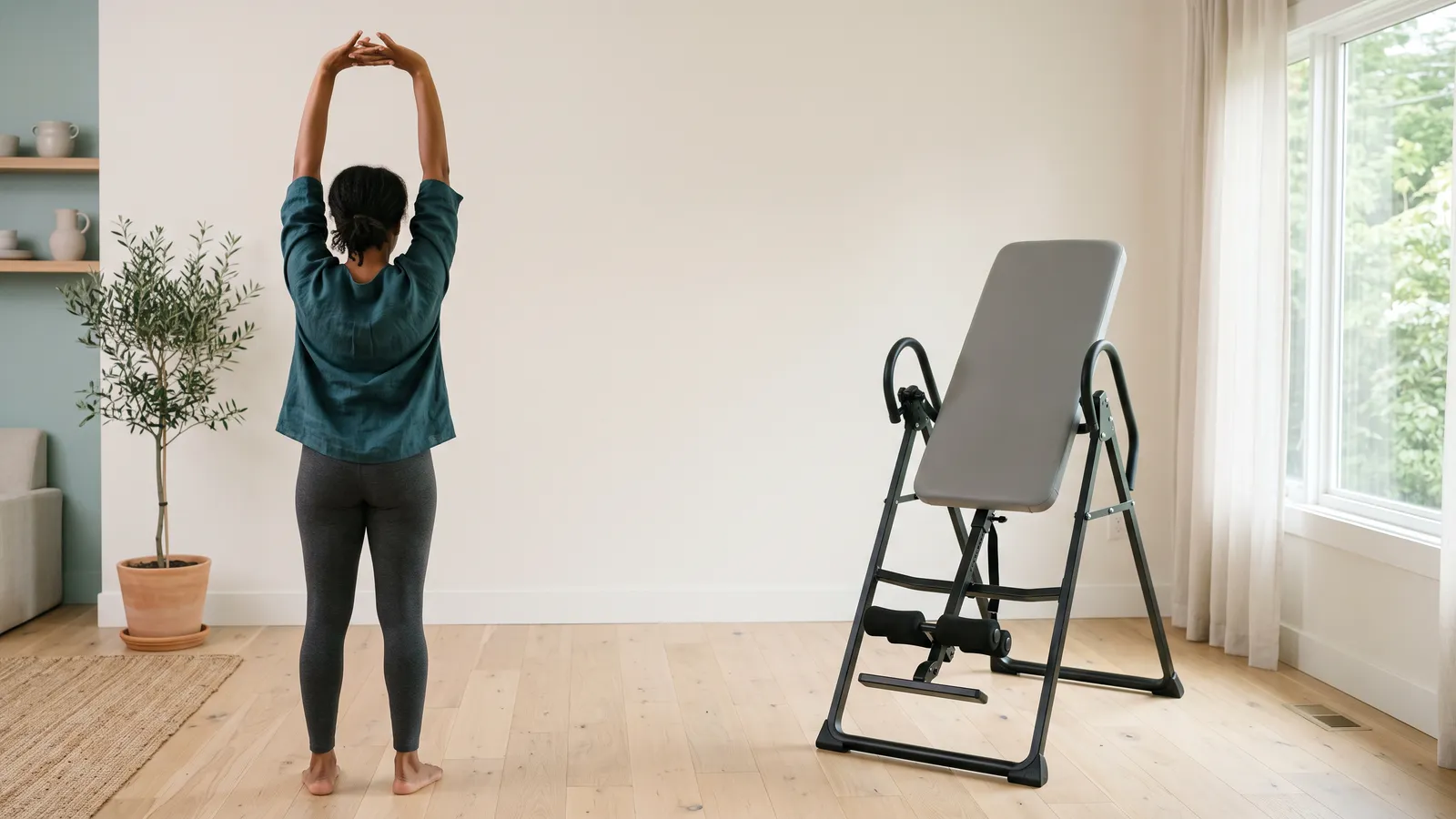
Inversion tables are not for everyone. Read who should not use one first.
What "exercise" means on an inversion table
Healthline says that, depending on the brand and model, some people exercise on an inversion table, and that some choose a model that allows torso rotations and ab crunches. Other makers describe gentler options. Teeter's FitSpine manual describes gentle stretching and twisting while partly or fully inverted, plus rhythmic rocking ("oscillation") and alternating inversion with rest periods ("intermittent traction").
So the range is wide. At one end is hanging still and relaxing. At the other is moving a lot while inverted. The further you go toward movement, the more the manual matters.
What Teeter's manuals warn against
Both Teeter manuals we read say the same thing in slightly different words.
- Do not use weights, elastic bands or any other exercise or stretching device while on the table.
- Do not use aggressive movements.
- The EP-850 manual warns that aggressive exercises involving vigorous body movement "can cause the table to tip over, resulting in serious injury or death."
- Do not attempt full inversion until you are comfortable with partial inversion.
We have not read every maker's manual, and other brands may allow more. Check the one that came with your table.
Keeping it simple
- Get comfortable with the basic routine first. See how to use an inversion table.
- Stay at a small angle while you learn how the table moves. See what angle to invert at.
- Breathe slowly and relax. Teeter's manual says the better you can relax, the more benefit you will feel. We cannot confirm that claim.
- If you want to add movement, do only what your manual describes, slowly and smoothly.
- Come back up slowly, without lifting your head or sitting up.
Exercise before or after a table session
Some people ask whether to use the table before or after a workout. We did not find a health source that answers this, so we do not give a rule. Ask your doctor or physiotherapist.
Common questions
Can I do sit-ups on an inversion table?
Healthline says some people choose a model that permits ab crunches. Teeter's manuals say not to use aggressive movements. Whether crunches are allowed depends on your table, so check its manual.
Can I hold weights?
Teeter says no. Other makers may say the same.
Is it a workout?
Cleveland Clinic describes inversion as a way to stretch. Teeter describes it as relaxation and gentle stretching. We would not call a table a replacement for your usual exercise.
Gear that helps
If you plan to move on the table, look at how stable it is, how secure the ankle lock feels, and what the maker's manual says about movement. See best inversion tables and best heavy-duty inversion tables.
Sources
Related
- How to use an inversion table safelySetup and first-session steps drawn from Teeter's owner's manuals and health sources: footwear, ankle lock, balance test, spotter, and how to come back up.
- What angle should I invert at?What the makers and health sources say about starting angles, working up gradually, and why angle scales differ between tables.
- Who should not use an inversion tableWho should talk to a doctor before trying an inversion table, when to stop, and how to start carefully. Written from health sources and the makers' own manuals.
- Best inversion tablesSeven inversion tables chosen from the makers' published specs: who each suits, weight and height limits, warranties, and who should not invert.