How to assemble and adjust an inversion table
Last updated 2026-10-20 · Written by Inversion Guide editorial team
For information only. This page is general product information, not medical advice. Talk to your doctor or physiotherapist before using an inversion table.
Inversion tables are not for everyone. Read who should not use one first.
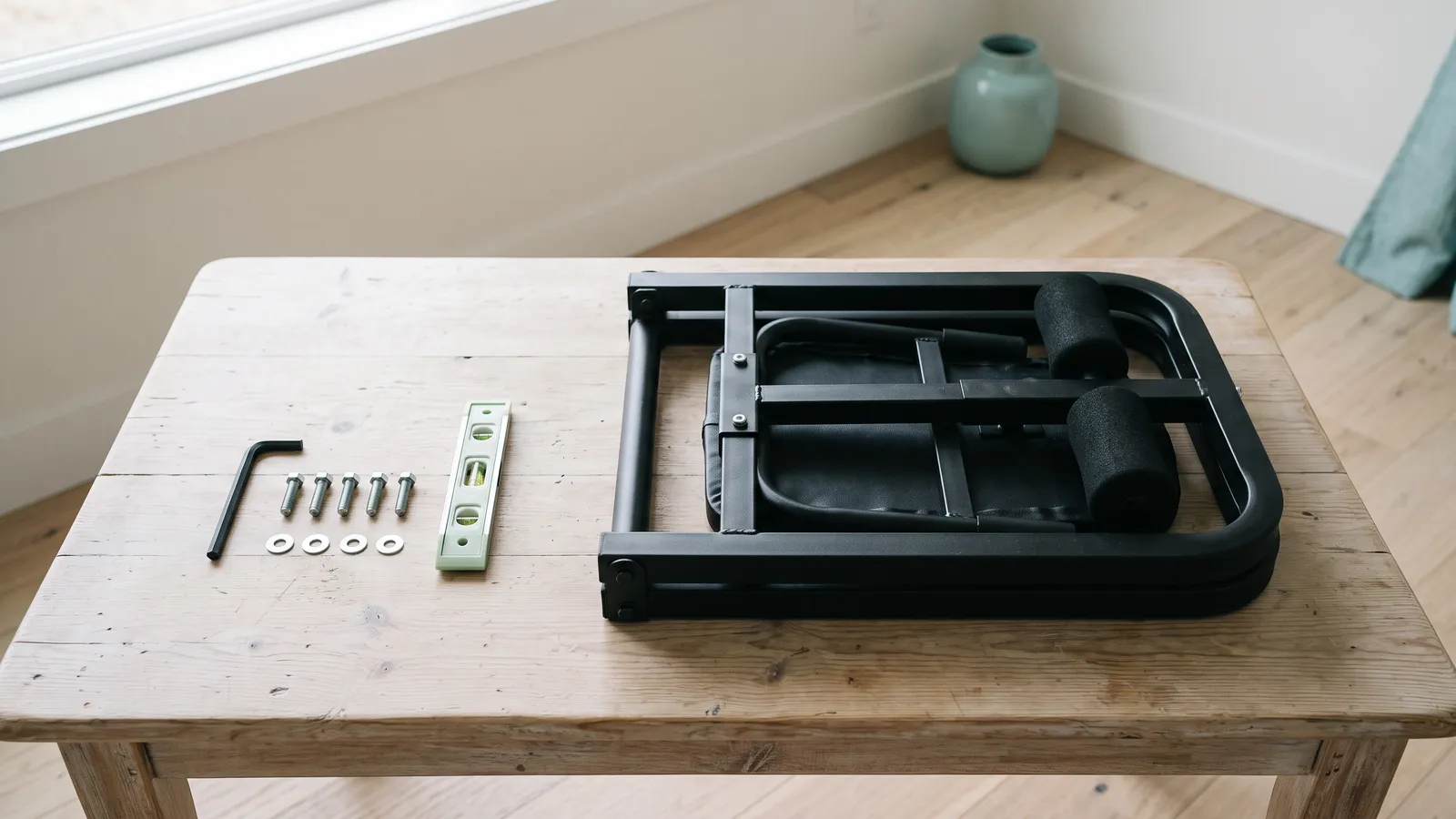
Assembling an inversion table
Teeter says its tables are designed for easy assembly at home, with a free interactive 3D app and a printed guide, and lists professional assembly through a partner as an option. Innova's FAQ adds a few practical points:
- Its bolts use nylon lock nuts, so you will not be able to tighten them fully by hand: Innova says to use two wrenches, one holding the bolt and one turning the nut.
- The right and left base frames are different. Innova says the right side is as you use the table, not as you face it, and describes a warning sticker and a metal piece on the right side to tell them apart.
- Innova's ITX1200 page lists "all parts and hardware to install" as included and links an installation video that it says does not replace the owner's manual.
Whichever table you have, put it on a level surface away from water or ledges, as Teeter's manual says, and check that all fasteners are secure before use and again before each session.
How to adjust the height setting on an inversion table
The height setting moves the balance point so the table rotates smoothly. It is the setting people most often get wrong.
Teeter (FitSpine manual): pull out the height-selector locking pin and slide the main shaft until the last setting you can read is one inch greater than your height. For example, at 5 ft 10 in, the last numbers visible should be 5 ft 11 in. Release the spring-loaded pin so it passes completely through the shaft. Teeter says your ideal setting depends on your weight distribution and could vary several inches either side of your actual height.
Innova (FAQ): adjust the height adjustment tube to your height number and tighten the angle selector pin. Innova says your height setting may or may not be your actual height, because the center of gravity varies with height and weight distribution, and that the headrest also helps you find it.
Testing your balance
Teeter's test: lean back with your head on the table and arms at your sides. If balanced correctly, the table should begin to rotate slightly, with the main shaft lifting a few inches off the crossbar. If it rotates a long way, toward horizontal or beyond, the setting may be too short, so dismount, lengthen it by one hole, secure your ankles and test again. If it does not rotate at all, it may be too long, so shorten it by one hole and test again. Teeter says to ask a spotter for your first few sessions until you find your setting.
Innova's FAQ gives the same idea in its own words: if the table does not invert, move the height adjustment tube up one position at a time; if it inverts too quickly, move it down one position at a time.
Set the angle limit
Teeter's tables use an angle tether: attach it under the table bed, then slide the buckle to shorten or lengthen it and pre-set your maximum angle. Teeter says to attach it for your first sessions. Innova's tables use a pin: you position the pin in the desired angle. Innova says new users should begin at a low setting (15 or 30 on its scale). Scales differ between brands; see what angle to start at.
The ankle lock check
Teeter's manual says to hear, feel, see and test the ankle lock every time you use the table: it should be snug, close-fitting and fully engaged, and you should try to pull your feet through the ankle cups and find that you cannot. It also says to wear securely tied lace-up shoes with a flat sole, not boots, high-tops or anything above the ankle bone. Innova likewise advises athletic shoes and a snug but not over-tight ankle system, since tightening too much can restrict blood flow.
Before each session
- Check that the table rotates smoothly and all fasteners are secure, with room in front, above and behind you.
- Check the tether or pin, the height setting and the ankle lock.
- Have someone nearby, and come back up slowly. Teeter says not to sit up or lift your head, but to bend your knees and shift your weight toward the foot end, and to rest just past horizontal before standing.
More detail in how to use an inversion table.
Folding and storing it
Teeter's steps: disconnect the tether, slide the main shaft to the storage setting, rotate the bed against the crossbar, then pull up on the spreader arms, leaving the legs open 16 to 20 inches for stability. Innova's steps are similar: remove the safety pin, pull up the handlebars, and put the pin back in the hole near the tip of the base frame. Both say to store it so it cannot tip: leave the frame wide enough to stay stable, or secure it to a wall. Teeter says to lay it flat if children are present, and Innova says no one should use it in storage mode. If you leave it open, Teeter says to secure it so it cannot rotate, using the tether or a key lock. See folding inversion tables for folded sizes.
Safety
Inversion tables are not for everyone. Read who should not use one first, and talk to your doctor before you try one if you have any health condition.
Sources
Related
- How to choose an inversion tableWeight limit and height range first, then ankle system, angle control, folding and warranty: a checklist built from the makers' own published specs.
- How to use an inversion table safelySetup and first-session steps drawn from Teeter's owner's manuals and health sources: footwear, ankle lock, balance test, spotter, and how to come back up.
- What angle should I invert at?What the makers and health sources say about starting angles, working up gradually, and why angle scales differ between tables.
- Best folding inversion tablesAll seven inversion tables we cover fold for storage. What the makers publish about folded size, weight and how to fold, so you can plan the space.
- Who should not use an inversion tableWho should talk to a doctor before trying an inversion table, when to stop, and how to start carefully. Written from health sources and the makers' own manuals.