Teeter FitSpine X1 review
Last updated 2026-10-20 · Written by Inversion Guide editorial team
Disclosure: if you buy through our links, we may earn a commission at no extra cost to you. As an Amazon Associate I earn from qualifying purchases.
For information only. This page is general product information, not medical advice. Talk to your doctor or physiotherapist before using an inversion table.
Inversion tables are not for everyone. Read who should not use one first.
Quick facts
- Max user 300 lb
- Height 4'8"–6'6"
- Max angle 180°
- Folds
- Mid-range
Prices change often. Check the current price on Amazon.
Who it's best for
- Newcomers who want the FlexTech backrest at a lower price than the X3
- People within 300 lb and 4 ft 8 in to 6 ft 6 in who are happy with a simple ankle closure
- Anyone who wants the lightest FitSpine, at about 60 lb
Who should look elsewhere
- Anyone who struggles to bend forward to the ankles: it uses a T-pin closure, not EZ-Reach
- People who want angle markings on the tether or Stretch Max handles
- Anyone over 300 lb or taller than 6 ft 6 in
What we like
- FlexTech backrest with 8-point floating suspension, as on the more expensive FitSpine models
- Includes Lumbar Bridge and Acupressure Nodes
- Lightest FitSpine at about 60 lb
- 5-year full warranty is included
Keep in mind
- T-pin ankle closure, not the EZ-Reach system, so you bend further forward to lock in
- Basic angle tether and grip-and-stretch handholds; no EZ-Angle markings or Stretch Max handles
- 300 lb and 6'6" limits
Our take
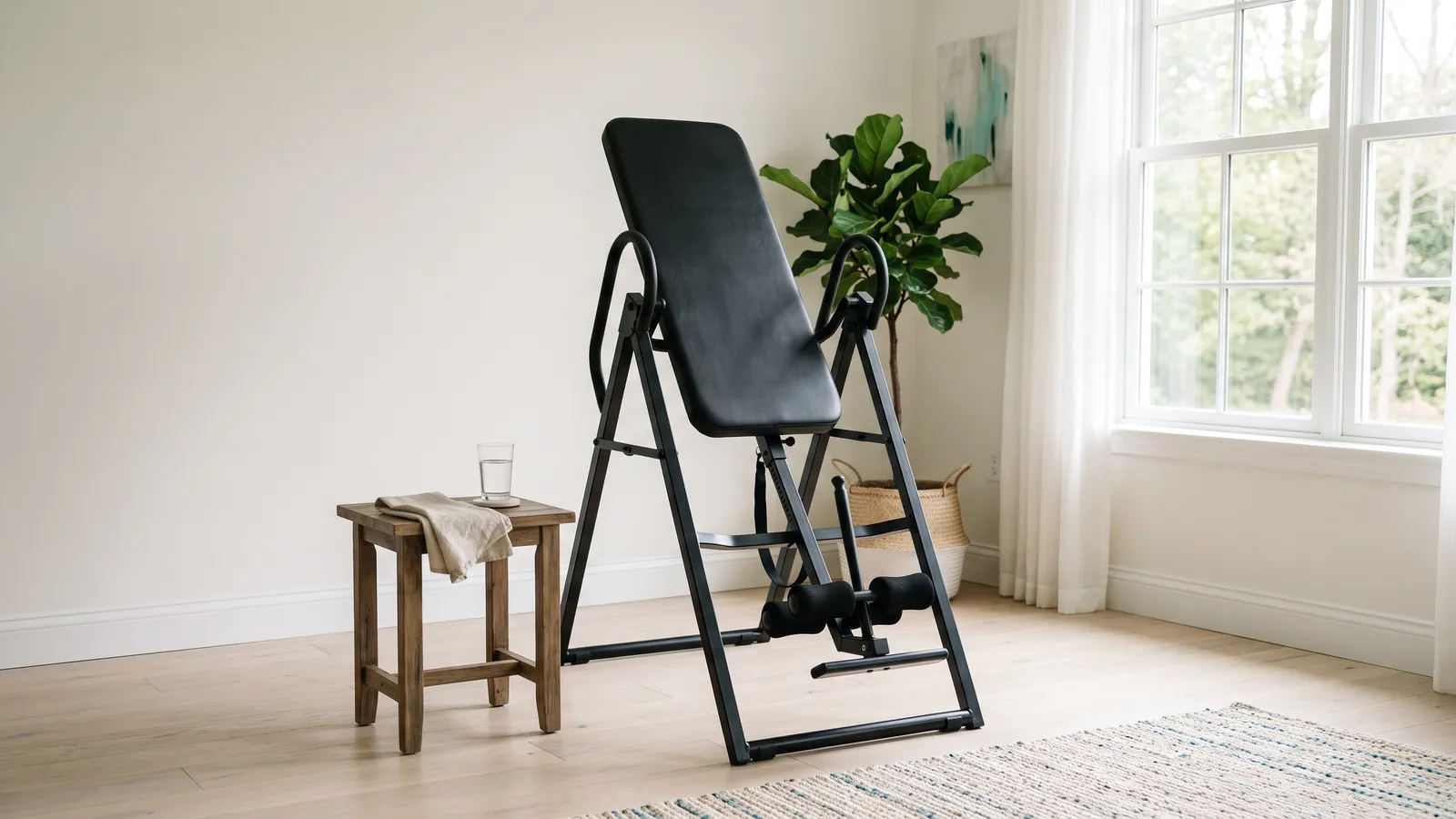
The FitSpine X1 is the entry point to Teeter's FitSpine line. It keeps the FlexTech backrest with its 8-point floating suspension, includes a Lumbar Bridge and Acupressure Nodes, and carries the 5-year full warranty. What it drops compared with the X3 is the easier ankle system and the angle markings.
We research, we don't test, so what follows is based on Teeter's published information. Picks are based on product specs, owner reviews and expert sources, linked below.
What stands out
At about 60 lb it is the lightest of the FitSpine tables, which helps if you move it to put it away. The backrest suspension is the same design as on the more expensive models, so you are not stepping down to a plain backrest. The 300 lb and 6 ft 6 in limits match the rest of the Teeter range in our set.
The downsides
The ankle closure is a T-pin, not the EZ-Reach system, so you bend further forward to lock in. If reaching your ankles is already uncomfortable, the extra cost of the X3 may be worth it. The angle tether is basic and the handholds are grip-and-stretch style: there are no EZ-Angle markings and no Stretch Max handles. You will need to be more careful and deliberate about repeating your starting angle. Read what angle to start at and follow your manual.
The maker's numbers
Teeter lists the X1 at a 300 lb capacity, a 4 ft 8 in to 6 ft 6 in height range and a product weight of 60.3 lb. It measures about 81 x 28.8 x 86.5 in in use and 20 x 28.8 x 66 in folded for storage, the same footprint as the X3. The warranty is a 5-year full warranty included with the table.
What it shares and what it drops
From Teeter's page, the X1 keeps the FlexTech backrest, the 8-point floating suspension, the Ergo-Embrace ankle supports, the Ankle Comfort Dial, a 3-setting roller hinge and the option of full inversion with a lockout. What it changes is the ankle closure and the tether. The X1 uses a spring-loaded T-pin ankle lock with a T-shaped grip instead of the X3's extra-long EZ-Reach handle, so you bend further forward to close it. Its tether sets a partial angle, but Teeter does not describe the 20, 40 and 60 degree embroidered markings on the X1's page. It also does not list the Stretch Max or EZ-Stretch handles. Accessories shared with the bigger models include the lumbar bridge, acupressure nodes and headrest pillow.
How it compares
The X1 sits between the EP-560, which has a different ComforTrak backrest, and the X3. The practical test is the ankle step. If you can reach your ankles comfortably, the X1 gets you the FlexTech backrest at a lower tier. If bending forward is awkward, the X3's longer handle is the reason to pay more. Full side-by-side in Teeter X3 vs LX9, and our general advice on the ankle system is in how to choose an inversion table.
Common questions
Does the X1 have the EZ-Reach handle?
No. Teeter lists a spring-loaded T-pin closure on the X1. The EZ-Reach handle is on the X3 and LX9.
Is it lighter than the X3?
Teeter lists 60.3 lb for the X1 and 65.8 lb for the X3.
Is it right for me?
Inversion tables are not for everyone, and the research on them is limited and mixed. Some people find a table eases back stiffness for a while, but it is not a treatment. Talk to your doctor first, and read who should not use an inversion table.
Space and storage
Plan for the in-use footprint, not the folded one. Teeter lists about 81 x 28.8 in of floor and 86.5 in of height while you are on the table, and about 58 x 28.8 x 60.5 in in its non-use position. Folded for storage it is 20 x 28.8 x 66 in, so it can stand against a wall. At 60.3 lb it is the lighter of the two FitSpine models we cover that you might move yourself, but still a two-handed job.
Who it suits
The X1 suits people who want the FitSpine backrest and a long warranty without paying for the extras. It sits next to the EP-560, which costs less still but has a simpler ComforTrak backrest and no FlexTech suspension. If you want easier ankle access, look at the X3.
Inversion tables are not for everyone. Read who should not use one first, and talk to your doctor if you have any health condition.
Specs (as stated by the maker)
| Max user weight | 300 lb |
|---|---|
| User height | 4'8"–6'6" |
| Max angle | 180° |
| Folds | Yes |
| Ankle system | Ergo-Embrace ankle supports with T-pin closure |
| Warranty | 5-year full warranty (included) |
How it compares
- Teeter FitSpine X3 review: Teeter's main inversion tableTeeter FitSpine X3: who it suits, who should look elsewhere, the maker's published specs, and how it compares with the LX9, X1 and EP-560.
- Teeter EP-560 review (Hang Ups)Teeter EP-560: who it suits, who should look elsewhere, the maker's published specs, and how it compares with the FitSpine X1 and Innova ITX9600.
Sources
Related
- Best inversion tablesSeven inversion tables chosen from the makers' published specs: who each suits, weight and height limits, warranties, and who should not invert.
- Teeter inversion tablesA short factual summary of Teeter, based on the company's own site, and a link to our Teeter inversion table reviews.
- Who should not use an inversion tableWho should talk to a doctor before trying an inversion table, when to stop, and how to start carefully. Written from health sources and the makers' own manuals.