Teeter FitSpine X3 review: Teeter's main inversion table
Last updated 2026-10-20 · Written by Inversion Guide editorial team
Disclosure: if you buy through our links, we may earn a commission at no extra cost to you. As an Amazon Associate I earn from qualifying purchases.
For information only. This page is general product information, not medical advice. Talk to your doctor or physiotherapist before using an inversion table.
Inversion tables are not for everyone. Read who should not use one first.
Quick facts
- Max user 300 lb
- Height 4'8"–6'6"
- Max angle 180°
- Folds
- Mid-range
Prices change often. Check the current price on Amazon.
Who it's best for
- People within 300 lb and 4 ft 8 in to 6 ft 6 in who want Teeter's main table
- Anyone who finds bending forward to reach their ankles awkward, because the EZ-Reach handle is extra long
- Beginners who want a tether with 20, 40 and 60 degree markings so the starting angle is easy to repeat
Who should look elsewhere
- Anyone over 300 lb or taller than 6 ft 6 in, because both limits are firm
- People who want the lowest Teeter price: the EP-560 and FitSpine X1 share the same limits for less
- Anyone who has to carry the table often, as it weighs roughly 66 lb
What we like
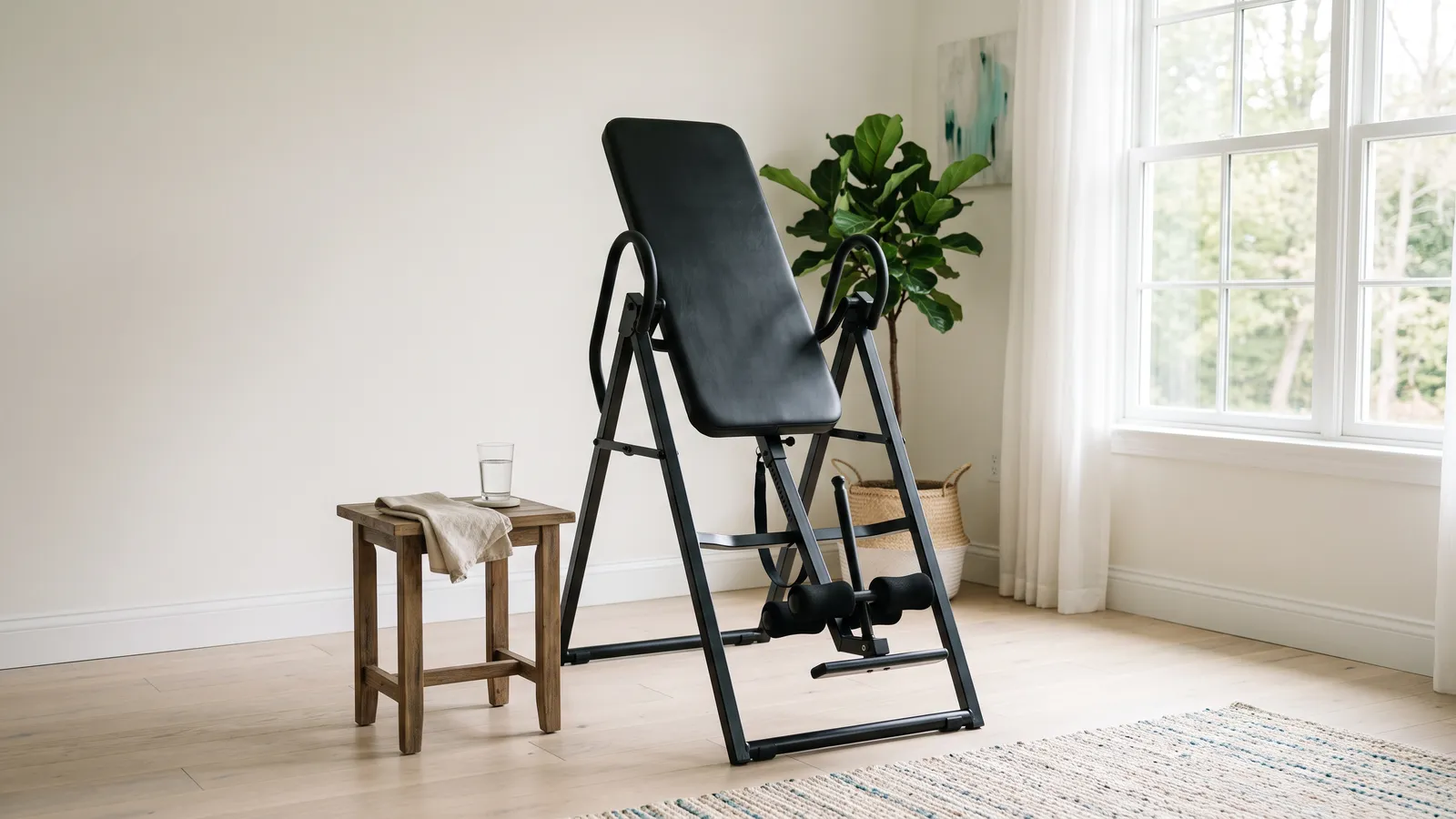
- EZ-Reach ankle system has an extra-long handle, so there is less bending forward to secure your ankles
- EZ-Angle tether with embroidered 20, 40 and 60 degree markings makes the starting angle easy to repeat
- FlexTech backrest on an 8-point floating suspension; Stretch Max and EZ-Stretch handles for stretching at different angles
- 5-year full warranty is included
Keep in mind
- 300 lb and 6'6" are hard limits; taller or heavier users need a different design
- Roughly 66 lb, so it is awkward to move even though it folds for storage
- Costs more than the EP-560 and FitSpine X1, which share the same weight and height limits
Our take
The FitSpine X3 is Teeter's main table. It sits in the middle of the FitSpine range: it has the better ankle system and angle controls of the top model, the LX9, without the raised boarding platform or the higher cost. We chose it as our best overall pick because its published limits fit a wide range of adults, it is easy to set up and repeat, and Teeter includes a 5-year full warranty.
Picks are based on product specs, owner reviews and expert sources, linked below. We research, we don't test, so everything here comes from what Teeter publishes about the table.
What stands out
The EZ-Reach ankle system has an extra-long handle, so you reach the lock without folding far forward. A second, gravity-activated lock backs it up. For many people the ankle step is the awkward part of using a table at all, so this matters more than it sounds.
The EZ-Angle tether has embroidered markings at 20, 40 and 60 degrees. That makes it simple to start at a small angle and come back to the same setting next time. If you are new to inverting, read what angle to start at first, and follow your own manual.
The backrest is Teeter's FlexTech design on an 8-point floating suspension, and there are Stretch Max and EZ-Stretch handles for stretching at different angles. Teeter's own manuals warn against aggressive movement on the table, so see what makers allow for exercise before you get ambitious.
The downsides
Both limits are firm. If you are over 300 lb or taller than 6 ft 6 in, this is not the table; the Innova ITX1200 is the only table in our launch set verified to 350 lb. At roughly 66 lb it folds for storage but is still awkward to move. And it costs more than the EP-560 and the FitSpine X1, which have the same weight and height limits. Whether the X3's ankle system and handles are worth the step up is the real question.
The maker's numbers
From Teeter's own product page: a 300 lb weight capacity, a height range of 4 ft 8 in to 6 ft 6 in, and a product weight of 65.8 lb. In use the table measures about 81 x 28.8 in on the floor and 86.5 in high, so you need a clear space of roughly 7 ft by 3 ft plus headroom. Teeter lists non-use dimensions of 58 x 28.8 x 60.5 in, and storage dimensions of 20 x 28.8 x 66 in, which is the folded footprint to plan around. The warranty is a 5-year full warranty included with the table; Teeter sells a 5-year extension as an add-on, which we do not count.
How it compares
Against the LX9, the X3 has the same backrest, suspension, ankle system and tether markings. What the LX9 adds is the raised boarding platform, an arched frame, a storage caddy and about 8 lb of extra weight. Against the X1 and EP-560, the X3 is the one with the extra-long ankle handle, the secondary gravity-activated lock and the Stretch Max handles. Our side-by-side is in Teeter X3 vs LX9, X1 and EP-560. If you are weighing Teeter against its main rival, see Teeter vs Innova.
Setup and first sessions
Teeter says the table suits assembly at home and offers a free interactive 3D app for the steps. Whatever table you own, the order that matters is the same: set the height setting, attach the angle tether, check the ankle lock every time, and ask someone to stay nearby while you find your balance setting. Our assembly and adjustment guide walks through what Teeter's manual says, and how to choose a table explains the limits above in more detail.
Common questions
Does it fold?
Teeter says the X3 folds easily for storage. Its storage dimensions are 20 x 28.8 x 66 in, and at 65.8 lb you will want to decide where it lives before you move it.
What angles can I set?
The tether has embroidered markings for 20, 40 and 60 degrees, and Teeter describes full inversion as an option. Start small and follow what angle to start at.
Is it right for me?
Inversion tables are not for everyone, and the research on them is limited and mixed. Some people find a table eases back stiffness for a while, but it is not a treatment. Talk to your doctor first, and read who should not use an inversion table.
Who it suits
Choose the X3 if you are inside the limits, want an ankle lock that is easy to reach, and would rather pay once for a longer warranty than save money now. Choose something else if budget is the main driver, if you are heavy or very tall, or if getting on and off the table is the hard part: the LX9 adds a raised boarding platform for that.
Inversion tables are not for everyone. Read who should not use one before you buy, and talk to your doctor first if you have any health condition.
Specs (as stated by the maker)
| Max user weight | 300 lb |
|---|---|
| User height | 4'8"–6'6" |
| Max angle | 180° |
| Folds | Yes |
| Ankle system | Deluxe EZ-Reach ankle lock with extra-long handle and secondary gravity-activated lock |
| Warranty | 5-year full warranty (included) |
How it compares
- Teeter FitSpine LX9 reviewTeeter FitSpine LX9: who it suits, who should look elsewhere, the maker's published specs, and how it compares with the X3 and X1.
- Teeter FitSpine X1 reviewTeeter FitSpine X1: who it suits, who should look elsewhere, the maker's published specs, and how it compares with the X3 and EP-560.
Sources
Related
- Best inversion tablesSeven inversion tables chosen from the makers' published specs: who each suits, weight and height limits, warranties, and who should not invert.
- Teeter inversion tablesA short factual summary of Teeter, based on the company's own site, and a link to our Teeter inversion table reviews.
- Who should not use an inversion tableWho should talk to a doctor before trying an inversion table, when to stop, and how to start carefully. Written from health sources and the makers' own manuals.
- What angle should I invert at?What the makers and health sources say about starting angles, working up gradually, and why angle scales differ between tables.