Teeter gravity boots review
Last updated 2026-10-20 · Written by Inversion Guide editorial team
Disclosure: if you buy through our links, we may earn a commission at no extra cost to you. As an Amazon Associate I earn from qualifying purchases.
For information only. This page is general product information, not medical advice. Talk to your doctor or physiotherapist before using an inversion table.
Inversion tables are not for everyone. Read who should not use one first.
Quick facts
- Max user 300 lb
- Height TBD–TBD
- Max angle 180°
- Folds: TBD
- Mid-range
Prices change often. Check the current price on Amazon.
Who it's best for
- Experienced users who already invert and want a portable option for a sturdy chin-up bar
- People with no floor space for a table
Who should look elsewhere
- Beginners: start with a table that lets you control the angle
- Anyone over 300 lb, or over 250 lb if using Teeter's chin-up rack
- Anyone without a bar that is sturdy enough and the right size
What we like
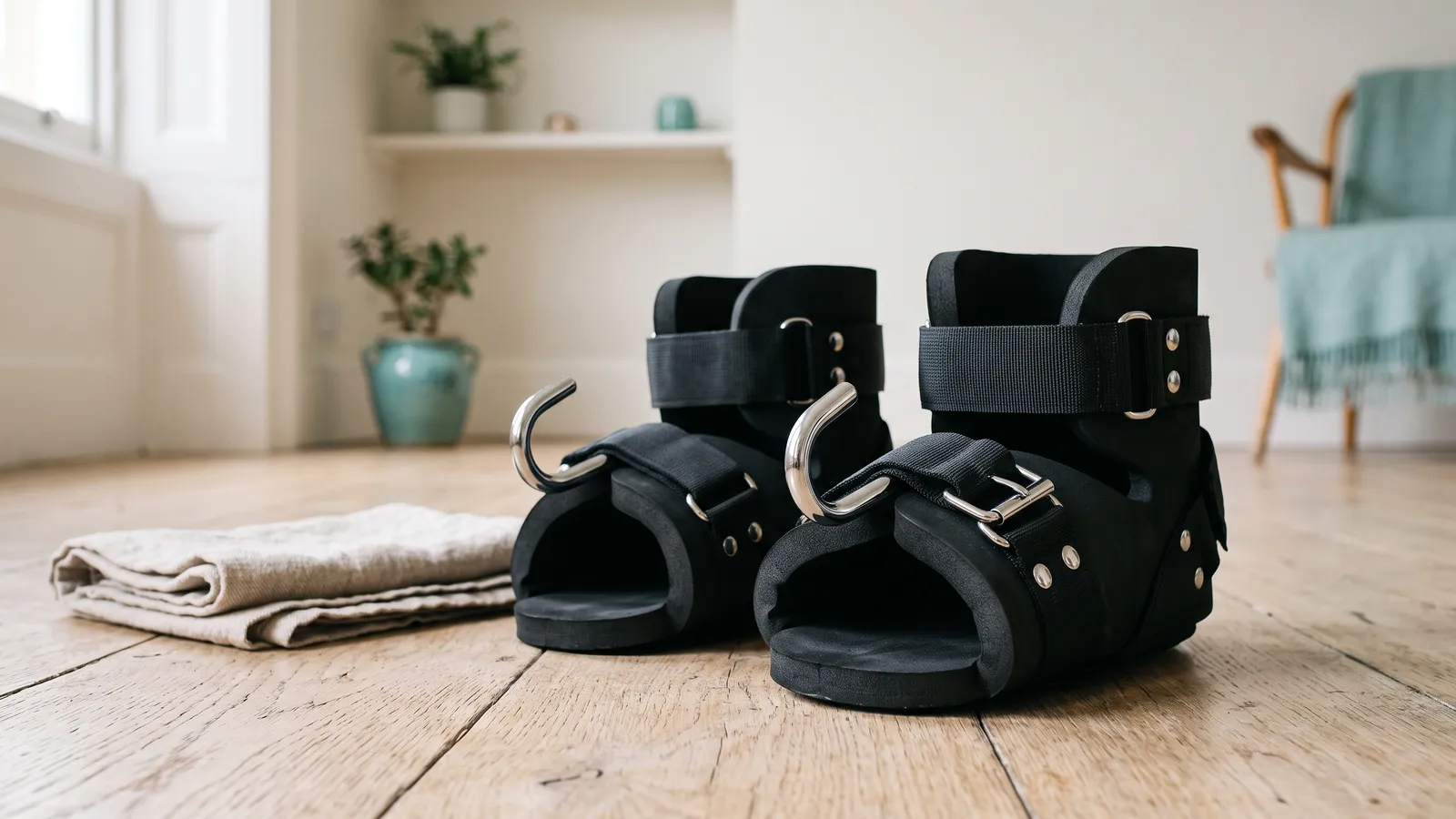
- Two double-locking ratchet buckles per boot and 5/8 inch foam liners
- Standard and XL sizes; fit bars up to 1.25 inch in diameter
- Optional calf loops reduce load on the knees and tops of the feet
- 5-year full warranty is included
Keep in mind
- Rated to 300 lb, and the optional chin-up rack to 250 lb
- Needs a sturdy bar you supply (or the Teeter rack for 28 to 36 inch wooden doorframes); no angle control, you hang fully inverted
- Not a good first step: inverting without a table takes experience
Our take
Teeter's Gravity Boots are the one product in our launch set that is not a table. They suit a narrow group: people who already invert, who have a bar they trust, and who want something that stores in a drawer. For everyone else, a table that lets you choose a small angle is a better starting point.
We research, we don't test, so this review is built from Teeter's published information. Picks are based on product specs, owner reviews and expert sources, linked below.
What stands out
Each boot has two double-locking ratchet buckles and 5/8 inch foam liners. They come in standard and XL sizes and fit bars up to 1.25 inch in diameter. Optional calf loops reduce load on the knees and the tops of the feet. Teeter includes a 5-year full warranty.
The downsides
The boots are rated to 300 lb, and Teeter's optional chin-up rack to 250 lb. You supply a sturdy bar, or buy the Teeter rack, which Teeter describes as fitting 28 to 36 inch wooden doorframes. There is no angle control: you hang fully inverted. That is the key difference from a table, where a tether or pin sets how far back you go. It is also why we do not suggest boots as a first step; inverting without a table takes experience, and the bar you hang from matters as much as the boots.
The maker's numbers
From Teeter's page: the boots are rated to 300 lb and weigh 5 lb a pair. The standard size is 9 in long and fits calves under 16 in around; the XL is 10.5 in long and fits 16 in and up. Both fit bars up to 1.25 in in diameter, with 2.5 in hooks that Teeter says let the bar sit deeper. Teeter's optional chin-up rack weighs 19 lb, is rated to 250 lb and screws into a solid wood doorframe. The warranty on both is a 5-year full warranty.
What you are responsible for
With boots, the weak link is rarely the boot itself. You supply, or buy, the bar, and its rating must exceed your weight with margin. Teeter's rack is designed for solid wood doorframes, so a hollow or unknown frame is not a place to try this. There is no tether or pin: a table lets you choose a small starting angle, while boots put your feet above your head. That is why the general advice in our safety guide about spotters, slow movement and checking your fastenings matters even more with boots.
How it compares
Boots are the most portable route and the one with the least control. A table such as the X3 or EP-560 takes up floor space but lets you start at a small angle and come back up by shifting your weight. If you are unsure which suits you, how to choose an inversion table is the better starting point, and the question of seated devices is covered in inversion chair vs inversion table.
Common questions
Do I need a table too?
No. The boots hook over a bar, and Teeter sells a doorway chin-up rack to hold them. Whether you want one without angle control is a separate question; see above.
Does Teeter publish a height range?
No. A height range does not apply to boots, which is why they are not part of our height-based roundups.
Is it right for me?
Inversion tables are not for everyone, and the research on them is limited and mixed. Some people find a table eases back stiffness for a while, but it is not a treatment. Talk to your doctor first, and read who should not use an inversion table.
Who it suits
Boots suit someone with prior experience who has weighed the risks, checked the bar's rating against their weight, and wants portability. If you are new to inversion, or have any health condition, start with the FitSpine X3 or EP-560, where you can begin at a small angle, and ask your doctor first.
Inversion is not for everyone. Please read who should not use an inversion table.
Specs (as stated by the maker)
| Max user weight | 300 lb |
|---|---|
| User height | TBD–TBD |
| Max angle | 180° |
| Folds | TBD |
| Ankle system | Two-buckle double-lock ratchet closure with foam liners |
| Warranty | 5-year full warranty (included) |
How it compares
- Teeter FitSpine X3 review: Teeter's main inversion tableTeeter FitSpine X3: who it suits, who should look elsewhere, the maker's published specs, and how it compares with the LX9, X1 and EP-560.
- Teeter EP-560 review (Hang Ups)Teeter EP-560: who it suits, who should look elsewhere, the maker's published specs, and how it compares with the FitSpine X1 and Innova ITX9600.
Sources
Related
- Best inversion tablesSeven inversion tables chosen from the makers' published specs: who each suits, weight and height limits, warranties, and who should not invert.
- Teeter inversion tablesA short factual summary of Teeter, based on the company's own site, and a link to our Teeter inversion table reviews.
- Who should not use an inversion tableWho should talk to a doctor before trying an inversion table, when to stop, and how to start carefully. Written from health sources and the makers' own manuals.